
March 24, 2026
War abroad, strain at home, and changes to voting. The sheep are starting to see a pattern.

The sheep have been following several developments this week that, on the surface, appear unrelated. One concerns war abroad. Another concerns airports and immigration enforcement at home. A third involves the rules governing how Americans vote. Taken together, however, the sheep believe they tell a more complete story about the current moment.
They began with the situation in Iran.
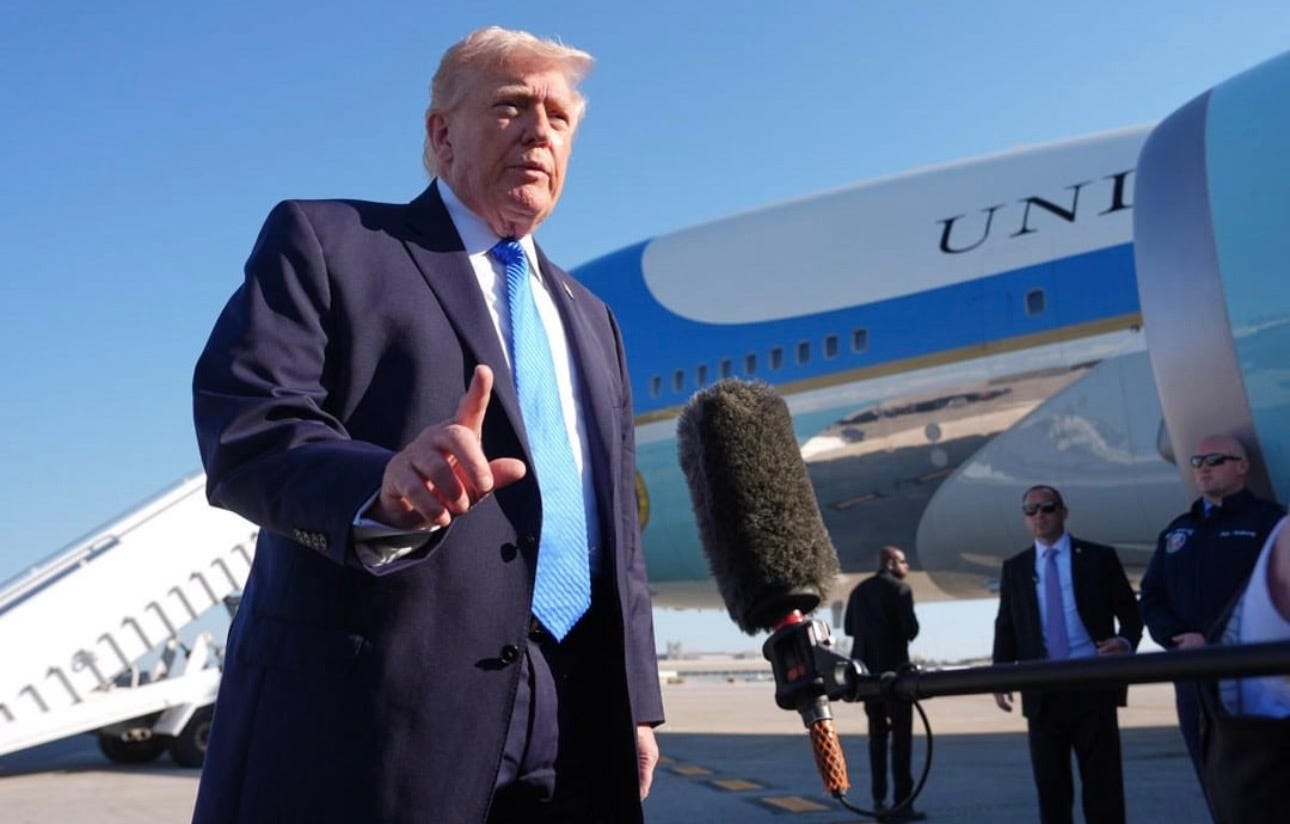
President Trump announced that he would delay his threat to “obliterate” Iran’s power plants for five days, explaining that the United States and Iran had held what he described as “very good and productive” talks toward a “complete and total” resolution of the war. He suggested that Iran wanted to settle and that both sides had reached major points of agreement, including reopening the Strait of Hormuz, preventing Iran from ever obtaining a nuclear weapon, and removing enriched uranium.
Iran’s government responded by denying that any such talks had taken place. Officials in Tehran described the claims as false and characterized them as psychological warfare and market manipulation. The sheep noticed the gap between the two accounts. On one side, there is a narrative of progress and negotiation. On the other, a flat rejection that any negotiation is happening at all.
What stood out most to the sheep was not only the contradiction, but the suggestion that any agreement could amount to a form of regime change. That language implies an outcome far more significant than a ceasefire or a diplomatic settlement. It suggests a fundamental reshaping of another country’s government, framed as part of a negotiation that one side says does not exist.
While the situation abroad remains unclear, the sheep have also been watching developments at home, particularly in the nation’s airports.
Amid a partial shutdown of the Department of Homeland Security, more than 400 TSA officers resigned and thousands more called out, leaving airports understaffed and strained. In response, the administration deployed Immigration and Customs Enforcement officers to more than a dozen airports to help ease delays. Officials said the ICE officers were not screening passengers and that no arrests had been reported, but the presence of immigration enforcement personnel in airport operations drew immediate attention.
President Trump suggested that if conditions worsened, he could deploy the National Guard as well. At the same time, the broader funding dispute that caused the staffing shortages remains unresolved. Republicans have insisted on fully funding DHS, including ICE and Customs and Border Protection. Democrats have pushed for funding TSA separately while seeking limits on ICE’s enforcement tactics, including clearer identification requirements and restrictions on certain practices.
The sheep found themselves focused less on the procedural details and more on the image itself. Airports, already places of heightened security, now include immigration enforcement officers stepping into roles created by a funding crisis. It is a small shift in function, but one that signals how quickly responsibilities can blur when institutions are under strain.
The Senate also voted to advance Markwayne Mullin’s nomination to lead the Department of Homeland Security, positioning him to replace Kristi Noem. The leadership of that agency will shape how these tensions unfold in the months ahead.
At the same time, the sheep have been watching a case before the Supreme Court that could change how Americans vote.
The Court appears likely to limit the counting of mail-in ballots in federal elections. The case centers on a Mississippi law that allows absentee ballots to be counted if they are postmarked by Election Day but arrive within five business days afterward. At least 13 other states have similar rules.
Republican officials argue that federal law requires ballots not only to be sent by Election Day but also received by that day. Several justices appeared sympathetic to that argument, raising concerns about confidence in election outcomes and the appearance of fraud. Other members of the Court questioned whether such a ruling could also call early voting practices into question.
The sheep noticed that the case is not only about timing. It is about access. Mail-in voting expanded in recent years as a way to make participation easier for people who cannot vote in person. Changing those rules does not eliminate voting, but it can narrow the window in which participation is possible.
A ruling is expected soon.
As the sheep considered these three developments together, they found themselves returning to a familiar pattern. There is uncertainty about war and negotiation abroad. There is strain within domestic institutions responsible for security and enforcement. There are ongoing efforts to define and redefine how elections are conducted.
Each of these developments can be understood on its own. Each has its own logic, its own set of arguments, and its own defenders.
But the sheep have learned that the broader picture often emerges only when these moments are viewed together.
They are watching a government that is simultaneously engaged in a costly and unclear conflict overseas, managing internal disruptions to critical agencies, and overseeing changes to the rules of democratic participation.
None of this arrives with a single announcement declaring a shift.
Instead, it unfolds in pieces.
The sheep are paying attention to how those pieces fit together.
Here in the UK, I find the sheep's point of view very interesting and educational for the current US politics - and all is explained very well. Thank you for being the sheep's voice in these very odd times.
It seems as if Trump is using ICE as "strike breakers" when he sends ICE to airports where they have no idea of what to do? Look for dark skinned people? That's not TSAs job. Direct Traffic? Look at people's ID in the security check lines? What next? he'll send ICE to be air controllers?