
March 25, 2026
The sheep step back and try to make sense of a week where nothing quite lines up.

The sheep have been watching a series of developments this week that, taken individually, feel complex and difficult to track. When placed together, however, they begin to form a picture that is harder to ignore.
They began with the movement of troops.
The Trump administration ordered the deployment of roughly 2,000 to 3,000 soldiers from the 82nd Airborne Division to the Middle East. Officials have not said exactly what those troops will be used for, and there has been no formal decision to send them into Iran. Still, the possibilities are clear. The troops could be used to reopen the Strait of Hormuz by force, seize strategic territory, or support operations targeting Iran’s nuclear program. They would join tens of thousands of American troops already in the region, along with additional Marines now heading there.
At the same time, the administration has been describing a very different version of events.
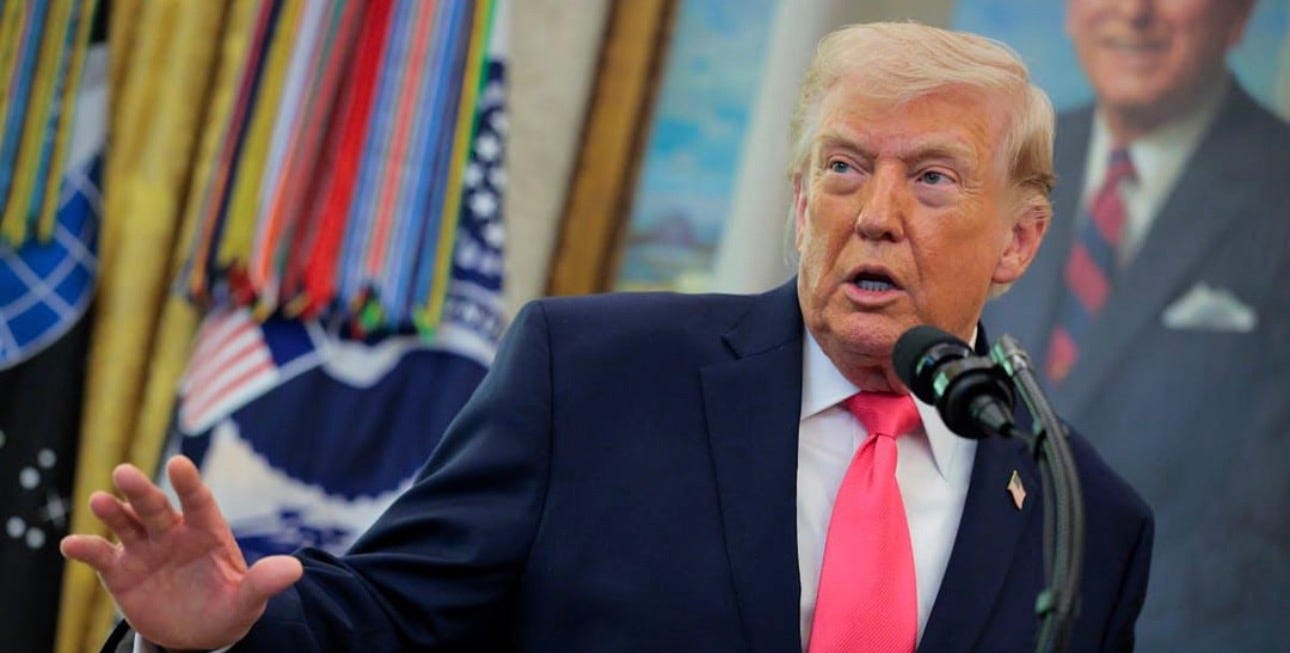
President Trump said the war had effectively been won and claimed that Iran was eager to negotiate. He described ongoing talks, suggested that Iran had agreed it would never develop a nuclear weapon, and said the United States was “talking to the right people.” He also referred to a “very big present” tied to oil and gas, though he did not explain what that meant.
Iran responded by denying that any negotiations were taking place at all.
The sheep noticed the contradiction. On one side, there is a narrative of victory and progress toward a deal. On the other, a complete rejection that any such process exists. Meanwhile, the fighting continues, with missile strikes across the region and no clear indication of how or when the conflict might end.
They then turned their attention back home.
The Department of Homeland Security remains partially shut down, and the effects are becoming visible. Airport lines are longer. TSA workers are missing paychecks. Absenteeism is rising. In response, Senate Republicans have proposed a plan to fund most of the department while excluding immigration enforcement operations tied to deportations.
The proposal is complicated. It would fund agencies like TSA, FEMA, and Border Patrol while delaying funding for deportation efforts, which Republicans hope to restore later through a separate legislative process. That second step faces significant obstacles, and even its sponsors have acknowledged that it may be nearly impossible to pass.
President Trump has expressed dissatisfaction with the proposal, while Democrats say it still fails to include the limits on immigration enforcement they have been demanding.
The sheep noticed that, once again, there is no clear resolution.
Congress is approaching a scheduled recess, but leaders have warned they may need to stay in session if the funding issue is not resolved. In the meantime, critical parts of the government continue operating under strain.
They also followed a lawsuit out of Minnesota that raised a different kind of concern.
State officials are suing the federal government to obtain evidence related to three shootings by federal officers during an immigration crackdown in Minneapolis. Two of those shootings were fatal. According to the lawsuit, federal agencies have refused to provide basic investigative materials, leaving state authorities unable to determine whether any laws were broken.
One of the cases involves a man who was initially charged with assaulting federal agents, only for those charges to be dropped after conflicting evidence emerged. Investigators are now examining whether federal officers may have provided false accounts of the incident.
The sheep found themselves focused on a simple point.
The state is arguing that it cannot allow federal agents to investigate themselves.
Another development added to their unease.
New reporting revealed that, in 2022, federal investigators obtained more than two years of detailed records connected to Kash Patel, who is now the director of the FBI. Those records included phone metadata, text logs, online account information, and banking details. At the time, investigators believed that disclosing the subpoenas could risk interference with their work.
The sheep noticed the contrast between that investigation and more recent statements about surveillance and data collection. The government has shown both an ability and a willingness to gather extensive information when it believes it is necessary.
They also observed a smaller but revealing moment.
A Justice Department prosecutor acknowledged that the government does not currently have evidence of fraud or criminal misconduct related to the Federal Reserve’s $2.5 billion renovation project. The investigation appears to have been driven in part by the scale of the cost overrun rather than clear evidence of wrongdoing.
The sheep have learned that suspicion alone can sometimes be enough to trigger scrutiny.
Then there was the matter of voting.
President Trump has repeatedly criticized mail-in voting, calling it fraudulent and insisting it undermines election integrity. Yet records show that he himself voted by mail in a recent Florida election, even though in-person voting was available to him.
The White House responded by saying there are exceptions that justify the practice.
The sheep did not need to discuss it at length. They simply took note.
Finally, they looked at the broader mood of the country.
Polls show that 36 percent of Americans approve of the president’s job performance, the lowest level since he returned to office. Approval of his handling of the economy is even lower. At the same time, nearly half of American workers now describe themselves as struggling, a shift that has not been seen in years. Fewer people believe it is a good time to find a quality job, and many are either searching for new work or feel trapped in their current positions.
The sheep understand that numbers like these are not just statistics.
They reflect how people are living.
As the sheep considered all of this, they found themselves returning to a familiar pattern.
There is a growing military presence abroad paired with conflicting narratives about diplomacy. There is strain within domestic institutions that are struggling to function smoothly. There are disputes over accountability, over evidence, and over who is responsible for enforcing the law. There are contradictions between what leaders say and what they do.
Each development can be explained on its own.
But taken together, they suggest something else.
The sheep are watching a system that feels increasingly unsettled, where clarity is rare, contradictions are common, and decisions of consequence continue to move forward without a clear sense of direction.
They are not yet certain what that means.
But they are paying attention.
I watched a beautiful sunrise today. That being said, the sheep were spot on as usual.