
The Airport Is Becoming Something Else
Airports are where governments rehearse the future in public. What began with hijackings and 9/11 may now be evolving into something even broader.

Airports are where governments rehearse the future in public.
That is one of the sheep’s working theories, and the American airport has done more than its share of proving it. The rules that shape air travel are rarely presented as experiments in state power. They arrive instead as temporary necessities, practical adjustments, regrettable but unavoidable responses to crisis. Then the crisis passes, the new powers remain, and the public learns to call the new arrangement normal.
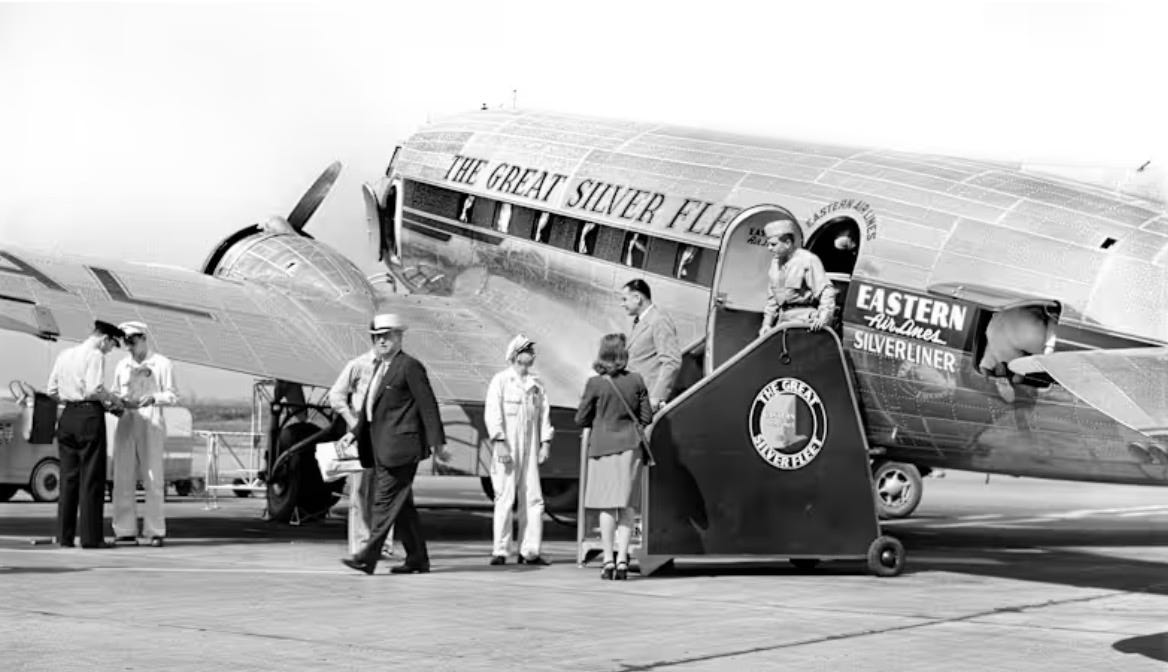
The United States did not begin the jet age with the kind of airport security Americans now accept as routine. For years, commercial flying involved relatively little screening. That began to change as a string of violent episodes forced the federal government to reconceive the airport as a place of preemptive control. In 1955, a bomb hidden in luggage destroyed a commercial airliner. In 1961, the United States saw its first skyjacking to Cuba. In 1962, federal authorities created the first Sky Marshal program. Then the hijacking wave of the late 1960s and early 1970s pushed the government toward a far more formalized system. On January 5, 1973, the FAA required passengers to pass through metal detectors and required carry-on bags to be X-rayed. That was a turning point. The airport ceased to be merely a place where people began a trip. It became a place where movement itself had to be earned through inspection.
After the attacks of September 11, 2001, that logic became permanent federal architecture. Congress passed the Aviation and Transportation Security Act, and on November 19, 2001, President George W. Bush signed it into law, creating the Transportation Security Administration. The responsibility for screening passengers and baggage moved decisively into the hands of the federal government. In 2006, after the transatlantic liquid explosives plot, Americans got the liquid restrictions that still shape what passengers can carry onboard. More recently, the federal government’s REAL ID requirements added yet another layer, turning ordinary domestic air travel into a more formal documentation regime. Over time, the airport became not simply a checkpoint for weapons, but a checkpoint for identity, eligibility, and compliance.
That history is worth keeping in mind because it clarifies the significance of what is happening now. In March 2026, amid a prolonged Department of Homeland Security funding standoff, the administration deployed ICE officers to assist at 14 airports after TSA staffing collapsed under the pressure of unpaid labor. Reuters reported that nearly 12% of TSA officers failed to report to work on one day, with absenteeism surpassing 30% at some airports, while wait times stretched beyond four hours in major hubs. ICE personnel were sent to airports including Atlanta, New York, Newark, New Orleans, Cleveland, Pittsburgh, Phoenix, and Fort Myers. Officials described the deployment as support for crowd control, ID checks, and exit-lane monitoring rather than immigration enforcement, but President Trump also publicly remarked that airports were “very fertile territory” for immigration arrests. That matters. It means the public is being asked to accept the physical presence of immigration enforcement in a space long framed as devoted to neutral travel security.
The sheep would point out that this is how institutional boundaries get softened in plain sight. A government does not need to announce a sweeping new domestic travel regime in order to move closer to one. It only needs to place new authorities in old spaces and let the public grow accustomed to the overlap. The airport is especially powerful terrain for that kind of shift because Americans have already been trained, over decades, to tolerate extraordinary measures there that they would reject almost anywhere else. Shoes off. Laptops out. Bottles discarded. Bodies scanned. Identification produced on command. The airport is one of the few places in American life where inconvenience, surveillance, and compulsory submission to federal procedure are not merely accepted but moralized as signs of civic seriousness.
That is why the recent incidents are so revealing. The AP reported this week on a controversial immigration arrest at San Francisco International Airport, where federal officers detained a woman while she was preparing to fly, with her child present. Officials said that case was not directly connected to the later ICE deployment at other airports during the shutdown. Even so, the larger picture is difficult to ignore. Americans are now watching immigration enforcement appear in and around the airport at the same moment that the administration is openly using immigration power as a central organizing principle of federal policy. Whether the authorities describe these episodes as separate or not, they are teaching the same lesson: the airport is no longer just where the government looks for dangerous objects. It is increasingly a place where the government may look for removable people.
The sheep cannot say with certainty what form this will take next, but the direction is not hard to imagine. A country that places immigration agents in airports during a funding crisis may find it easier to keep them there for other reasons later. A system that already links travel to screening and screening to identity may begin linking identity more explicitly to immigration databases, biometric tools, status verification, or selective secondary encounters. Some travelers would experience this as a minor annoyance. Others would experience it as a warning that domestic air travel is becoming contingent in a new way, less a public utility than a permission structure. That is an inference, not a formal policy announcement. But it is the kind of inference history teaches citizens to make before the paperwork arrives.
And that, the sheep suspect, is the real point. Every era of airport security in the United States has been justified by an emergency. Hijackings gave Americans metal detectors. September 11 gave them the TSA. The liquid bomb plot gave them the 3-1-1 rule. REAL ID turned domestic flying into a more explicit documentation checkpoint. Now a shutdown, an aggressive immigration agenda, and the insertion of ICE into airport operations are testing whether Americans will accept one more quiet redefinition of what the airport is for. If they do, the future of air travel may not be shaped mainly by where citizens want to go, but by how thoroughly the state decides it should be allowed to know them before they get there.
I’d like to see the change of having sufficient air controllers.
Oh, yeah…DEI need not apply.