
The Authoritarian Model Just Broke
Viktor Orbán spent sixteen years turning Hungary into a model for modern authoritarian politics. His defeat offers both a warning and a measure of hope for the United States.

The sheep have been watching Hungary because sometimes another country reaches the next chapter before you do.
Viktor Orbán’s blowout defeat this weekend matters not simply because a long-serving prime minister lost office, but because Orbán spent years building one of the most studied authoritarian projects in the democratic world.
Orbán, who had ruled Hungary for 16 years, was decisively defeated on April 12 by Péter Magyar and the center-right, pro-European Tisza party. With record turnout of about 80%, Tisza won 138 of 199 parliamentary seats, enough for a two-thirds supermajority, and Orbán conceded what he called a “painful but unambiguous” loss.
That is a remarkable result because Orbán was not merely an unpopular incumbent. He was the architect of a modern “illiberal democracy,” a man who spent more than a decade trying to make elections still exist while making genuine political competition weaker, slower, and less fair.
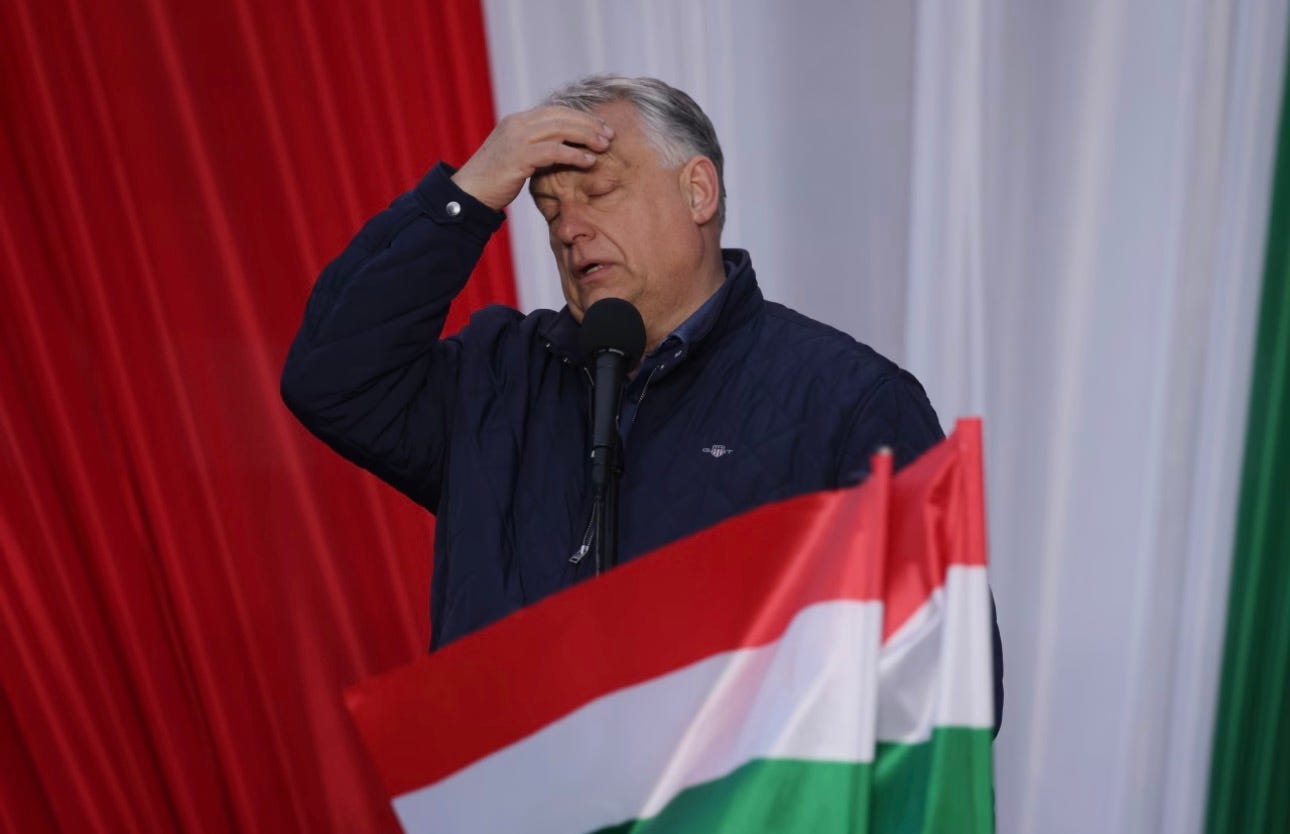
Orbán’s story is worth recalling because he did not begin as an obvious autocrat. He emerged in the late 1980s as an anti-Communist dissident and came to power first as a younger liberal nationalist. But after returning to office in 2010 with a parliamentary supermajority, he moved systematically to concentrate power. Over the years he rewrote the rules of Hungarian political life through media control, judicial changes, and election laws, while branding his project an “illiberal democracy.”
He used anti-immigration politics, attacks on liberal institutions, and cultural grievance to build a durable base, while also tightening control over the state, business, and much of the information environment.
The European Union froze billions in funding over concerns about democratic backsliding, corruption, media freedom, and judicial independence. This is what made Orbán so important to the global right. He offered a working model of how to hollow out democracy without formally abolishing it.
The sheep have long noticed that this is exactly why Donald Trump and his allies found Orbán so attractive. Orbán showed how a leader could keep the rituals of democracy while draining them of their substance. He showed how to turn migration into permanent emergency politics, how to cast universities, journalists, judges, and civil society groups as enemies of the nation, and how to use state power to reward friends, punish critics, and blur the boundary between party and government.
Orbán was openly admired by Trump and by important figures on the American right, including JD Vance. Trump endorsed him in this election, and U.S. conservatives had increasingly treated Hungary as a laboratory for the kind of nationalist, executive-centered politics they would like to reproduce at home.
That is why his loss matters for the United States.
First, it is a reminder that authoritarian politics are not invincible. Orbán had the advantages of incumbency, institutional capture, media leverage, and a fragmented opposition history behind him. He still lost badly when enough voters decided they had seen enough corruption, enough economic stagnation, and enough national humiliation disguised as strength.
This result is a major rejection of Orbán’s authoritarian governance, corruption, and antagonism toward Europe, driven heavily by young voters and by frustration over inflation, healthcare, and declining living standards. There is a lesson there for Americans. Strongmen often look unbeatable right up until the public decides the performance of dominance is no substitute for competent government.
Second, Hungary’s result is also a warning, not only a source of hope. Orbán’s defeat does not mean Orbánism vanished overnight. Fidesz still has deep influence across Hungary’s media, business, and judiciary, and Orbán’s years in power reshaped the institutional terrain itself.
In other words, a leader can lose office while his system remains partly embedded in the state.
The sheep would underline that because it speaks directly to the American situation.
Even if Trump is defeated politically, the larger damage of Trumpism does not disappear on election night. Once a movement has taught millions of people to distrust elections, courts, journalism, expertise, and the very idea of an independent civil service, the culture of authoritarianism can outlive the man who made it fashionable. Hungary’s election is proof that voters can remove an autocratic leader. It is also proof that rebuilding a democratic state after such a leader is slower and harder than defeating him.
Third, Orbán’s loss is a symbolic blow to Trump’s style of politics because Orbán was one of its most successful international validators. The result is a setback for the global far right and for allies of Trump and Putin. Orbán had positioned himself as a nationalist strongman close to Moscow, hostile to the EU, and eager to market “illiberal democracy” as the future. His defeat says something deeply inconvenient to every politician who claims liberal democracy is too weak, too decadent, or too old-fashioned to endure.
It says voters can still reject the whole performance. It says corruption, cronyism, and permanent grievance do not always produce loyalty forever. It says that authoritarian politics, however theatrical, still depend on people consenting to them.
The sheep would be careful, though, about drawing too neat a parallel.
Hungary is not the United States. It is smaller, more centralized, and Orbán had a much freer hand to reshape the political system over time. America’s federal structure, its larger and more fragmented media environment, and its stronger tradition of dispersed institutional power make imitation harder, though certainly not impossible.
The lesson is not that Trump will now inevitably suffer Orbán’s fate. The lesson is that the politics Trump admires have just suffered a serious and humiliating defeat in the country that served as their showcase. That matters because authoritarians depend not only on coercion and grievance, but on inevitability. They want opponents to believe resistance is futile, institutions are already dead, and the public has no real alternative.
Hungary just punctured that story.
So the sheep would put it this way: Orbán’s fall does not tell Americans to relax. It tells them two harder things at once.
It tells them that authoritarian systems can be beaten, even after years of corruption and institutional rot, if enough citizens refuse to treat them as permanent. And it tells them that if they wait too long, the victory comes with a much uglier repair job.
Hungary has shown that a strongman can lose in a landslide. The question for the United States is whether Americans will learn from that warning before they need the same kind of rescue themselves.
I would like to know how they did it in more depth. Independent journalism? Youth organization as you mentioned? We also need to know their methods. With their state media, it had to be a struggle. It’s a great day for democracy! Thank you for a great recap and cautionary advice.
So flipping great!!!