
The Judges Are Becoming the Last Fence Posts
District court judges were never meant to be the stars of American democracy. But at the moment, they may be the plain wooden posts keeping the whole field from collapsing.

The sheep have been thinking about fence posts.
Not the glamorous parts of a field, the gate with the fresh paint, the sweeping hill, or the dramatic sky. The fence posts are the plain, splintered things hammered into the ground at regular intervals, holding tension while everyone else admires the scenery. Most days, no one notices them at all. But when the animals start leaning hard on the wire, when weather turns violent, or when something large and unruly decides boundaries are optional, everyone remembers very quickly what the posts were for.
That, the sheep suspect, is where the lower court judges are now. They are becoming the last functioning fence posts in American democracy, the unglamorous infrastructure still trying to hold a constitutional shape while the executive branch increasingly treats the law like a suggestion box.
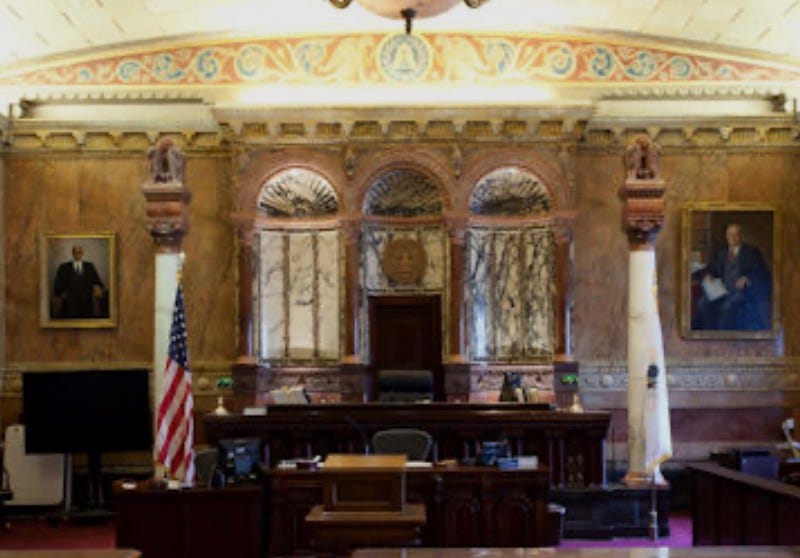
This is not a romantic role. District court judges do not usually get the marble-and-history treatment reserved for the Supreme Court. They issue emergency orders, parse statutes, review agency records, and force government lawyers to answer tedious questions they would rather avoid. Their work is procedural, often local, and usually ignored until it interrupts something theatrical. But in periods of executive overreach, procedure becomes principle in work clothes. The country starts to depend on people whose main talent is refusing to be impressed.
That is what has been happening across a striking range of cases. In March, a federal judge blocked the Trump administration from implementing a fast-track process that would have disposed of most immigration appeals without full notice-and-comment rulemaking, finding the administration had sidestepped basic legal requirements.
Around the same time, lower courts also pushed back against broader immigration detention policies, although the scope of one nationwide ruling was later narrowed on appeal.
In April, federal judges continued scrutinizing administration actions touching immigration, executive construction projects, and government retaliation against disfavored institutions. A federal judge in Washington, for example, allowed the American Bar Association’s lawsuit over Trump’s law-firm orders to proceed, saying the ABA had plausibly alleged an unlawful effort to intimidate firms based on disfavored speech and associations.
The sheep would note that these cases do not all fit neatly into one ideological story, which is precisely why they matter. They are not evidence that one faction of judges has suddenly decided to wage political war on the White House. They are evidence that ordinary judicial review still exists, at least in places, and that when executive power expands carelessly enough, even judges with different philosophies begin asking the same old questions. Where is the statutory authority? Who approved this? Did the agency follow the rules? What is the constitutional theory here, exactly? Those questions may sound dry, but dryness is sometimes what stands between a republic and a tantrum with federal resources behind it.
The tariff fights offer another example. In February, the Supreme Court struck down Trump’s sweeping global tariffs, ruling against his attempt to use emergency powers as a broad economic weapon. That was not a lower court ruling, but it grew out of the same larger pattern: judges asking whether a president can simply reclassify personal or political desire as legal emergency and expect the rest of the government to salute.
Reuters has also reported that the administration has been systematically racing emergency appeals to the Supreme Court in an effort to weaken the power of lower federal judges who have blocked or slowed its policies. That is an important detail, because it suggests the White House does not merely dislike adverse rulings. It dislikes the idea that district judges exist as a meaningful constitutional checkpoint at all.
That hostility has not stayed confined to legal briefs. Trump has publicly denounced judges who rule against him, including justices he appointed, and Reuters reported in March that federal judges have spoken out about rising threats, hateful messages, and even ominous pizza deliveries sent to their homes after rulings against parts of Trump’s agenda.
Another Reuters report from February described Trump’s fury after the tariff ruling, when he called justices an embarrassment and accused them of disloyalty. The pattern is hard to miss. First the executive branch stretches the law. Then judges object. Then the judges are recast as enemies, traitors, or illegitimate actors standing in the way of the people’s will. That is an old and ugly script. It is how power tries to make restraint look like sabotage.
The sheep have also noticed that lower court judges are being asked to defend norms that should not require this much emergency maintenance. The Department of Justice has moved to revive executive orders targeting major law firms, after lower courts blocked those orders on constitutional grounds.
Reuters reported that judges found serious First and Fifth Amendment problems in measures that sought to restrict firms’ access to federal buildings and penalize clients because the firms had represented Trump’s adversaries or participated in investigations involving him.
In a healthier political system, punishing lawyers for taking disfavored clients would be recognized immediately as a menace to the rule of law. In the current one, district judges have had to explain, patiently and on the record, why the government does not get to turn legal representation into an ideological loyalty test.
What makes this moment so consequential is not simply that judges are ruling against the administration. Presidents lose cases all the time. It is that lower court judges are increasingly acting as the only people in the federal system still willing to insist that text matters, process matters, jurisdiction matters, and constitutional limits are not optional simply because the executive branch is in a hurry or in a mood. That is not judicial heroism in the cinematic sense. It is something more modest and perhaps more important. It is institutional adulthood.
The sheep would put it this way: democracies do not usually fail because every guardrail vanishes at once. They fail because enough people decide that the guardrails are annoying. Procedure is mocked as obstruction. Courts are framed as political when they say no and wise when they say yes. The slow disciplines of democratic government begin to look weak beside the intoxicating speed of unilateral action. And eventually the country forgets that the things it calls bureaucracy were often just the everyday mechanics of preventing one person from doing whatever he pleased.
So yes, the lower court judges are becoming the last functioning fence posts. They are plain, frequently insulted, and forced to absorb a great deal of pressure from people who would prefer not to be told no. But that is what fence posts are for. They do not exist to be loved. They exist to keep the boundaries standing long enough for everyone else to remember why the field needed boundaries in the first place.