
The Pasture Doctrine
The sheep haven’t forgotten Venezuela, or the old imperial logic being dusted off to justify it.

For the sheep, history isn’t dusty books and old speeches. It’s patterns — the way power repeats itself, like a shepherd circling the same pasture year after year. There’s one doctrine in American history that tells the sheep everything they need to know about how the big shepherds think: the Monroe Doctrine.
What Was the Monroe Doctrine?
Nearly 200 years ago, in 1823, a U.S. president named James Monroe stood before Congress and said something that would echo through every century since: the Western Hemisphere — all of North and South America — was not to be treated like someone else’s playground. Europe, he said, could keep its affairs and wars to itself, but no more colonizing or interference in the Americas. If another empire tried to swoop in and control a country here, the United States would consider that a hostile act.
At its root were three main ideas:
Europe stays out of the Western Hemisphere’s affairs.
The U.S. won’t interfere in European wars.
The U.S. will view any attempt to take over an American republic as a threat.
It was less about global altruism and more about saying to the world: “Hands off our backyard.” That was meant to protect newborn Latin American republics from being recolonized after centuries under Spanish and Portuguese rule. But like all big pronouncements, it was as much about power as it was about principle.
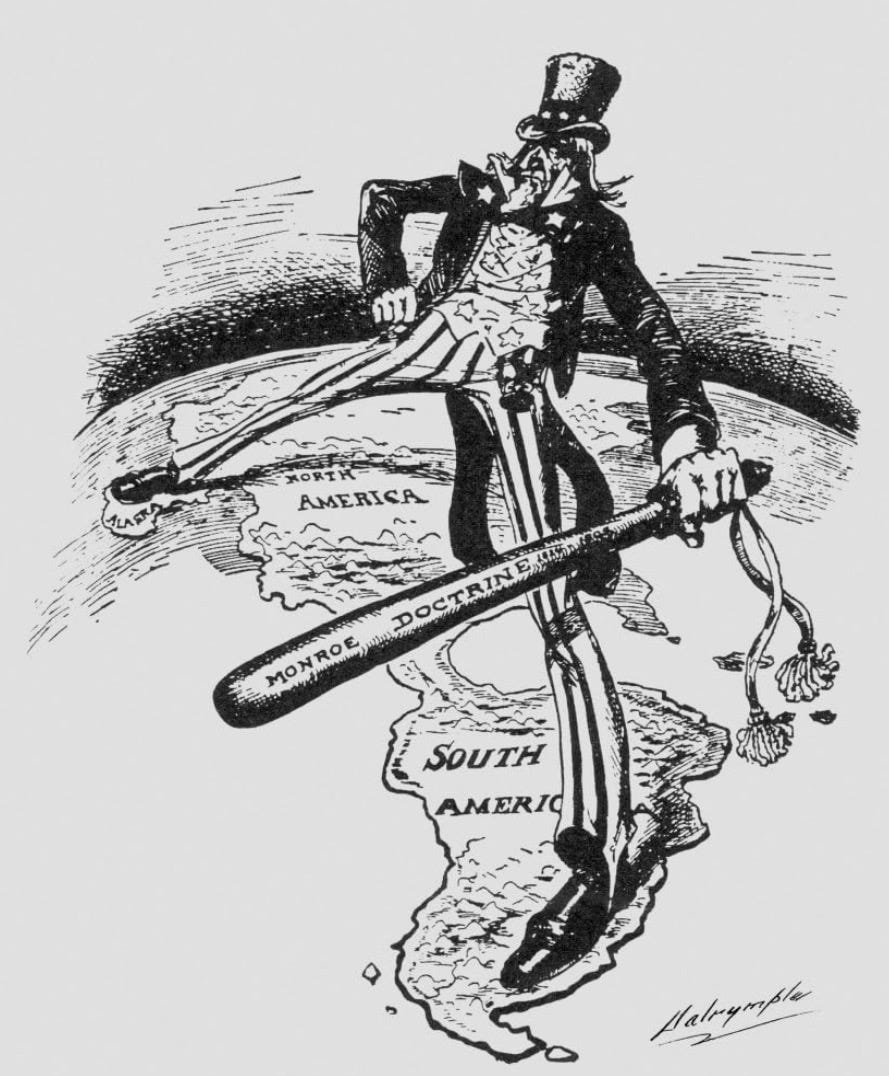
The Doctrine Grows Up
At first, the Monroe Doctrine was mostly words on paper — talk without much muscle behind it. As the United States grew stronger, future leaders found ways to stretch Monroe’s words into broader justifications for action.
In the early 20th century, Theodore Roosevelt added to it with something called the Roosevelt Corollary — effectively saying the U.S. could step in wherever it thought “disorder” or instability might invite outside powers to interfere. That was the beginning of a more muscular U.S. presence in the Caribbean and Central America.
Over decades, presidents used the doctrine to claim that the U.S. should have a major say in what happened in other nations nearby — often in the name of “security” or “stability.”
This was the historical backdrop of fires the sheep remember when the big shepherds marched into fields that weren’t theirs.
Now Enter the Modern Pasture
Fast-forward to 2025 and 2026.
