
The President Thinks the Court Belongs to Him
A justice is not supposed to be loyal to the president who appointed them. That is not a flaw in the system. It is one of the last signs the system is still working.

A president who believes judges owe him loyalty is not describing a constitutional system. He is describing a court he wishes he had.
That is what made Donald Trump’s recent complaint about the Supreme Court so revealing. After justices, including some he appointed, appeared skeptical of his effort to restrict birthright citizenship, Trump lashed out at them as “stupid people” and suggested they were trying to “show they’re independent” instead of backing him. The insult itself was not surprising. What mattered was the assumption underneath it: that justices appointed by a president should, in some meaningful sense, remain loyal to him. That is not a stray misunderstanding. It is a direct collision with the constitutional design of the United States.
The sheep have been thinking about that design because the framers did not separate power for the sake of elegance. They separated power because they understood something permanent about politics: power concentrates, power protects itself, and power almost always wants more. The American answer to that danger was to divide government into legislative, executive, and judicial branches, then give each branch both its own domain and the means to restrain the others. The system of checks and balances was built to ensure that no one branch would become too powerful. James Madison made the principle even plainer in Federalist 51, where he argued that government must not only control the governed but also be obliged to control itself.
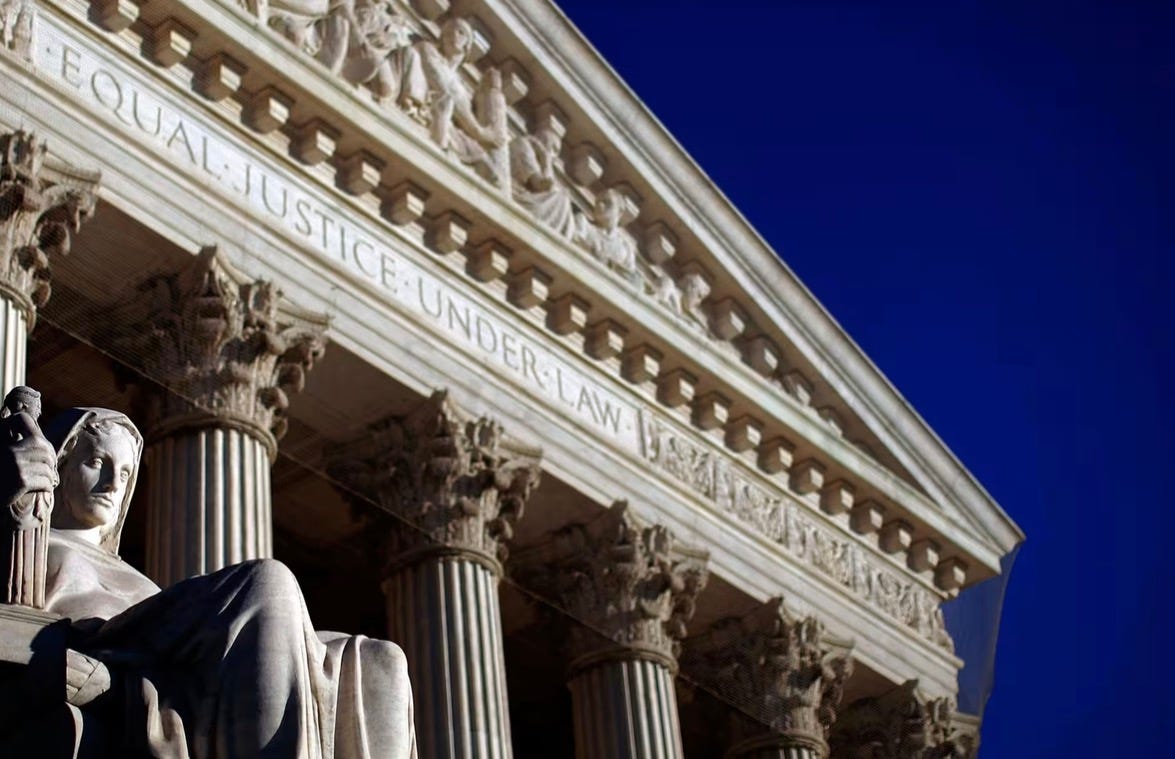
That is the point many Americans (and Trump apparently) lose sight of. Separation of powers is the machinery. Congress writes laws, controls spending, confirms many appointments, and can impeach officials. The president enforces the laws, commands the military, and can veto legislation. The courts interpret the law and determine whether acts of Congress or the president violate the Constitution.
These are not simply different job descriptions arranged neatly in a textbook chart. They are rival centers of authority designed to frustrate one another when necessary. Congress can check a president through appropriations, oversight, impeachment, and veto overrides. A president can check Congress with the veto. Courts can check both by invalidating unconstitutional actions.
The friction is the safeguard.
This is why Trump’s complaint matters. Federal judges are not meant to function as extensions of the executive branch. They are not advisers in robes, nor ceremonial validators of presidential will. Once appointed, they are supposed to decide cases independently, even when that means ruling against the president who elevated them. The National Constitution Center notes that the purpose of separation of powers is to prevent abuses of power and defend liberty by ensuring that no branch can simply absorb the others. A justice who rules against a president is not betraying the system. In many cases, that justice is proving the system still exists.
The present fight over birthright citizenship makes that especially clear. On April 1, the Supreme Court heard arguments over Trump’s executive order seeking to limit birthright citizenship, a move that several justices across ideological lines appeared to view skeptically. Reuters reported that Chief Justice Roberts, Justice Barrett, Justice Gorsuch, and Justice Kagan all pressed the administration’s reasoning. Trump attended the arguments in person, the first sitting president ever known to do so, then later publicly attacked justices who seemed unwilling to ratify his position. That sequence matters because it shows the gap between constitutional government and personalist government. In a constitutional system, a president argues a case and accepts that the judiciary may reject him. In a personalist system, the leader treats legal resistance as betrayal.
The sheep would add that the same logic extends beyond the courts. Congress, too, is not supposed to exist as a standing ovation for the White House. It is supposed to legislate, investigate, oversee, and restrain. When members of Congress begin treating loyalty to a president as more important than loyalty to their institution, the legislative branch weakens itself. When judges are expected to reward the man who appointed them rather than interpret the law, the judiciary becomes something else entirely. Separation of powers survives only so long as people inside these institutions behave as though their branch has an identity and duty distinct from the person currently holding the presidency.
That is why Trump’s remark should be read as more than one more eruption in a political culture already flooded with eruptions. It is a glimpse of how he understands public power. The American constitutional system assumes that branches will disappoint one another. It expects rivalry, delay, frustration, and refusal. It was built so that presidents would not command personal loyalty from judges, legislators would not govern as court attendants, and no single officeholder could convert electoral victory into ownership of the state.
When a president complains that justices are trying to “show they’re independent,” he is not identifying a defect in the constitutional order. He is identifying one of its core requirements. And in a moment like this, when so much else has bent toward obedience, that requirement begins to look less like an abstraction and more like one of the last remaining barriers between republican government and rule by a man who believes every institution should remember who put it there.