
The Quiet Return of the Draft Machinery
Automatic registration sounds administrative. The sheep suspect it is better understood as the quiet tightening of an old state power.

The sheep have been thinking about the difference between making a decision and making that decision easier to carry out later.
That is what makes the new move toward automatic Selective Service registration so important. The United States is not reinstating the draft today. There is no active military draft, and registration is not the same thing as induction into the armed forces. But beginning in December 2026, the federal government will shift from a system in which eligible young men are expected to register themselves to one in which the government registers them automatically by using existing federal data.
The Selective Service System says this change was mandated by the fiscal year 2026 National Defense Authorization Act, signed into law on December 18, 2025, and that it transfers responsibility for registration from individual men to the agency itself through integration with federal data sources.
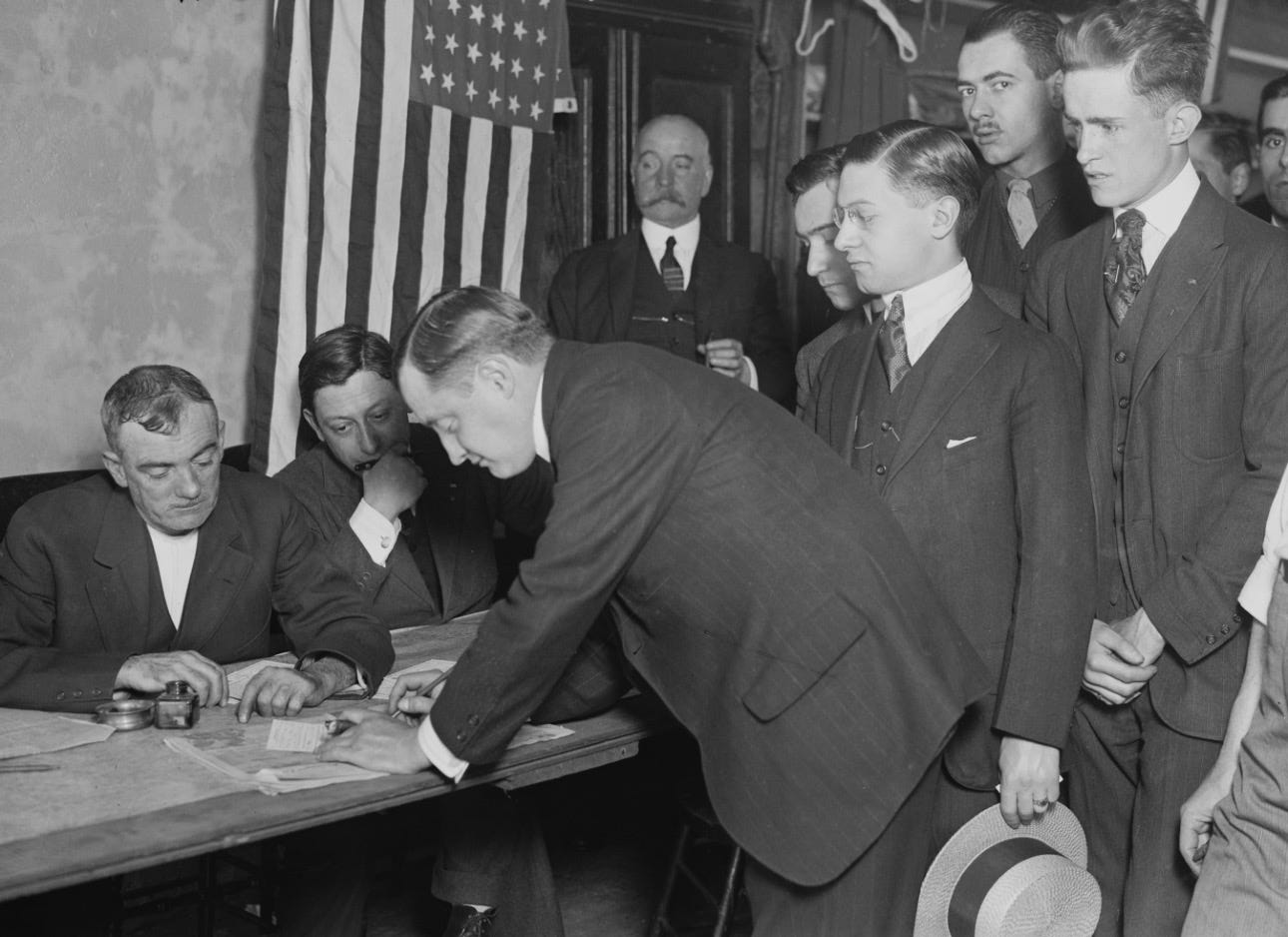
To understand why that matters, it helps to remember what conscription has meant in American history. The United States has often preferred to speak the language of volunteers, patriotism, and civic duty, but when war has demanded more bodies than enthusiasm could supply, the government has repeatedly turned to compulsion.
The first national draft law came during the Civil War. Congress passed the Enrollment Act on March 3, 1863, requiring the registration of male citizens and certain immigrants between the ages of 20 and 45. The law was deeply controversial, not least because men with money could avoid service by hiring substitutes or paying a commutation fee, a feature that helped fuel the New York City draft riots and left a lasting suspicion that compulsory service in America was rarely imposed equally.
The sheep would note that this is one of the recurring truths of conscription in the United States: it has almost always arrived wrapped in the language of national necessity, but it has also almost always raised deeper questions about class, fairness, citizenship, and the relationship between the individual and the state.
During World War I, Congress passed the Selective Service Act on May 18, 1917, after the United States entered the war in Europe. The law created the first national conscription system as Americans now generally understand it, and by the end of the war roughly 24 million men had registered while about 2.8 million were drafted. World War I was the first time the United States raised its army primarily through the draft rather than through volunteers alone.
Then came the first peacetime draft. On September 16, 1940, before the United States had formally entered World War II, Franklin Roosevelt signed the Selective Training and Service Act, requiring men between 21 and 45 to register. This normalized the idea that the government could prepare to compel service not only during active war but in anticipation of it. After World War II, conscription continued in different forms through the Cold War, Korea, and Vietnam. Men were drafted from 1948 to 1973 to fill vacancies that could not be met through voluntary enlistment.
Vietnam changed the politics of the draft permanently. The draft had always been controversial, but Vietnam made it toxic for a generation because it exposed, once again, the gap between official rhetoric and lived reality. The lottery system introduced in 1969 was supposed to make induction appear fairer, yet the war still convinced millions of Americans that the burden of compulsory service was falling on ordinary young men while the people making the decisions often escaped the consequences.
Nixon signed legislation ending induction authority in 1973. Registration itself was suspended in 1975. But the system did not disappear. It went into what the Selective Service System calls “deep standby,” preserved in case a future emergency required it. Then, in 1980, after the Soviet invasion of Afghanistan, Jimmy Carter revived draft registration for men ages 18 to 26. That is the registration regime the country has lived with ever since.
What changes now is not the existence of Selective Service, but who bears the burden of putting names into the system. Under the current framework, almost all male U.S. citizens and male immigrants ages 18 through 25 are legally required to register themselves. The Selective Service System says that includes many immigrants, refugees, asylum seekers, permanent residents, undocumented immigrants, and others living in the country. Failure to register has carried potential criminal penalties and collateral consequences, including barriers to federal jobs and, for some immigrants, citizenship.
The new law will remove the self-registration requirement and instead require the government to identify and register eligible men through other federal databases beginning in December 2026.
The sheep think that seemingly administrative shift has real political meaning. A self-registration system at least preserves one visible civic threshold. It requires the individual to take a step, and in doing so it reminds the country that draft readiness is not abstract. It depends on the citizen’s direct relationship to the state.
Automatic registration does something different. It makes the machinery quieter. It places the burden on the government to build the list itself, using data already in its possession, and in that sense it lowers one of the small frictions that once stood between public life and potential military mobilization.
The change was presented as a way to streamline the process, improve compliance, and reduce the effort spent on outreach and education. That may all be true. But efficiency is never just efficiency when the subject is compulsory military service.
This is where history becomes useful. Conscription systems are not only about whether a draft is active. They are about whether the government has already prepared the infrastructure needed to compel service quickly if political leaders decide to use it.
The United States has not had an active draft since the Vietnam era, but it has maintained the legal and administrative skeleton of one for decades. Automatic registration strengthens that skeleton. It does not mean a draft is imminent. It does mean the state is making sure fewer young men can slip through the cracks of the registration process, and it means that if Congress and a president ever choose to activate conscription again, the preparatory work of identifying the eligible pool will be easier, faster, and more complete.
The Selective Service System itself emphasizes that registration is not the same as enlistment or induction. But the whole purpose of registration is to make induction possible if the government decides it wants it.
The sheep would add that this change lands in a political moment when Americans are already nervous about how casually leaders are speaking about war. A rule change that might have seemed like dull administrative modernization in a calmer era looks different when the country is watching growing military confrontation abroad, heightened executive aggression at home, and a political culture that increasingly treats procedural guardrails as annoyances.
Conscription has always sat at the intersection of state power, citizenship, and war-making. Every time the federal government makes the draft apparatus more seamless, it is worth asking not only whether the process is more efficient, but what future choices that efficiency is preparing the country to make.
So the sheep would put it this way: the new automatic registration rule is not the draft itself, but it is the government quietly tightening the net. It is one more reminder that conscription in the United States has never truly vanished. It has merely moved in and out of public consciousness depending on whether leaders needed to use it.
In 1863, in 1917, in 1940, and again in 1980, the state adjusted its machinery for war in response to crisis or anticipated conflict. Now it is adjusting that machinery once more. The form is administrative. The implications are larger. A republic should pay close attention whenever the government makes it easier to sort its young into a pool of people who may one day be ordered to fight.
They can automatically register individuals for the draft, but not to register to vote. Got it. Not that I would want the federal government to do it anyway. I find it telling that federal officials have no problem registering non-citizen immigrants to fight, but don't want them to have health care, education or food.