
The Sheep Can See Only Two Explanations
When leaders describe a presidential threat as morally monstrous but still refuse to act, the sheep are left with only two plausible explanations.

The sheep have been trying, with limited success, to imagine a flattering explanation for congressional leadership.
They keep circling back to the same bleak conclusion. When faced with a president who threatens to destroy an entire civilization, flirts openly with war crimes, treats Congress as a decorative accessory, and continues to drag the country through corruption, lawlessness, and institutional vandalism, the leaders of both parties seem to offer some version of the same performance.
There is the grave statement, the dignified concern, the carefully worded condemnation, the suggestion that this is all deeply unfortunate. Then, too often, there is no corresponding action equal to the danger.
The sheep can only see two plausible explanations for that pattern. Either many of these leaders are, in substance if not in public language, more aligned with Trump’s project than they wish to admit, or they are so timid, self-protective, and attached to their own positions that preserving their standing inside the institution has become more important than defending the institution itself.
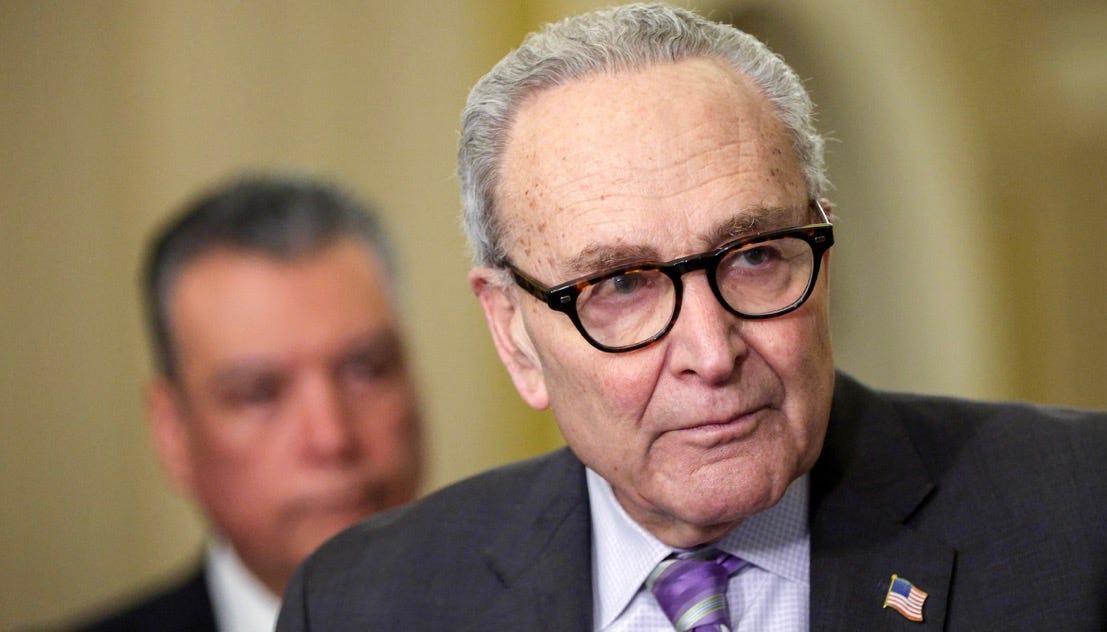
That judgment may sound harsh, but the events of this week have made gentler interpretations harder to sustain. On April 7, after Trump threatened that “a whole civilization will die tonight” in Iran, Senate Democratic leader Chuck Schumer joined Senators Chris Coons, Jeanne Shaheen, Jack Reed, and Brian Schatz in issuing a statement condemning the threat and calling attacks on civilian infrastructure a potential war crime and moral failure.
The statement was morally correct as far as it went. But it stopped at condemnation. It did not announce a concrete legislative response, a whip effort for immediate war powers action, an impeachment push, a funding cutoff, or any other mechanism equal to the scale of the emergency. At the same time, Trump’s threat drew global condemnation and alarm, while some Democrats and even a few Republican-aligned figures raised concerns about his fitness and rhetoric.
That gap between language and action is the part the sheep find most revealing. If congressional leaders truly believe a president is threatening conduct that would amount to a war crime, then ordinary statement politics is not a serious response. It is stagecraft.
Congress is not merely a forum for disapproval. It has powers. It can investigate, defund, constrain, censure, refuse cooperation, and in the most extreme cases pursue impeachment. To speak as though the danger is extraordinary while behaving as though the available response is a press release is to tell the public, intentionally or not, that the institution no longer means what it says about itself.
Republican leaders, of course, have made their own choice more plainly. Trump’s threat against Iran shocked world leaders and unnerved even some Republican allies, most Republican officials did not move to confront him meaningfully. The pattern has become familiar enough to feel almost procedural. Trump escalates. A few Republicans mutter concern. Most fall in line, excuse the rhetoric as negotiating theater, or simply wait for the news cycle to turn. Their inaction is easier to read than the Democrats’. In many cases, it is not weakness at all. It is assent. They may disagree with the wording, the timing, or the optics, but they continue to support the broader project of concentrated executive power, ethno-national grievance, institutional demolition, and personalist rule that Trump represents.
The sheep see very little evidence that the current Republican leadership views this as corruption of the system rather than its fulfillment.
The more painful question is what to make of Democratic leaders who clearly do not share Trump’s ideology, yet so often respond to constitutional emergency with the emotional energy of a beige lamp.
Here the sheep return to the second possibility: weakness dressed up as prudence. This is the pathology of leaders who still believe that sounding responsible is the same thing as exercising responsibility. They continue to speak as if the old incentives still govern American politics, as if decorum will eventually shame the shameless, as if a careful statement and another round of institutional throat-clearing will somehow restrain a movement that interprets restraint as permission.
The latest CNN poll conducted by SSRS helps explain why so many Democratic voters are furious with their own party. It found that only 28% of Americans view the Democratic Party favorably, while 56% view it unfavorably. That is not simply a messaging problem. It is what happens when large numbers of people conclude that a party sees the danger clearly enough to describe it, but not clearly enough to fight it.
The sheep do not believe every member of congressional leadership wakes up each morning plotting the republic’s collapse. They do, however, suspect that many of them have become captives of a political class culture in which protecting one’s future viability, committee standing, donor relationships, media reputation, and internal party status takes precedence over risk.
That sort of person does not always look villainous. Often he looks sober. Often she sounds strategic. Often they tell themselves that they are keeping options open, preserving leverage, waiting for the right moment, avoiding overreach. But history is full of leaders who confused delay with sophistication while the ground beneath them gave way.
So the sheep keep coming back to the same unsentimental conclusion.
Republican leaders are, with limited exceptions, functioning as accomplices to Trump’s destruction because they either support it outright or have decided that obedience is the price of survival.
Democratic leaders are more varied, but too many of them appear trapped in a softer failure, one rooted in institutional vanity, conflict aversion, and the narcissism of people who imagine their own carefulness to be a form of courage.
The country is being asked to watch this as though it were normal parliamentary drift. It is not. When the threat is this visible and the response is still calibrated to protect careers more than the constitutional order, the distinction between complicity and weakness begins to narrow.
In the end, both produce the same result: a Congress that can still speak, but no longer seems willing to act like a coequal branch of government.
Thank you! Excellent! And sad. No one willing to stand up to this.
Yes, this!!!