
The Sheep Have a Plan to Fix America
It starts with one blunt premise: nothing changes until private money stops owning public office.

You do not fix the outcomes until you fix the incentives.
As long as private wealth can dominate elections, access, and policymaking, the public is left choosing between puppets with different branding. Federal contribution limits still exist for direct donations to candidates, but independent expenditures remain unlimited, and super PACs can accept unlimited contributions. That legal structure is a big part of why wealthy donors and outside groups retain enormous influence.
So, the sheep’s position is simple: before America can solve most of its downstream problems, it has to reduce the dependency of elected officials on big money.
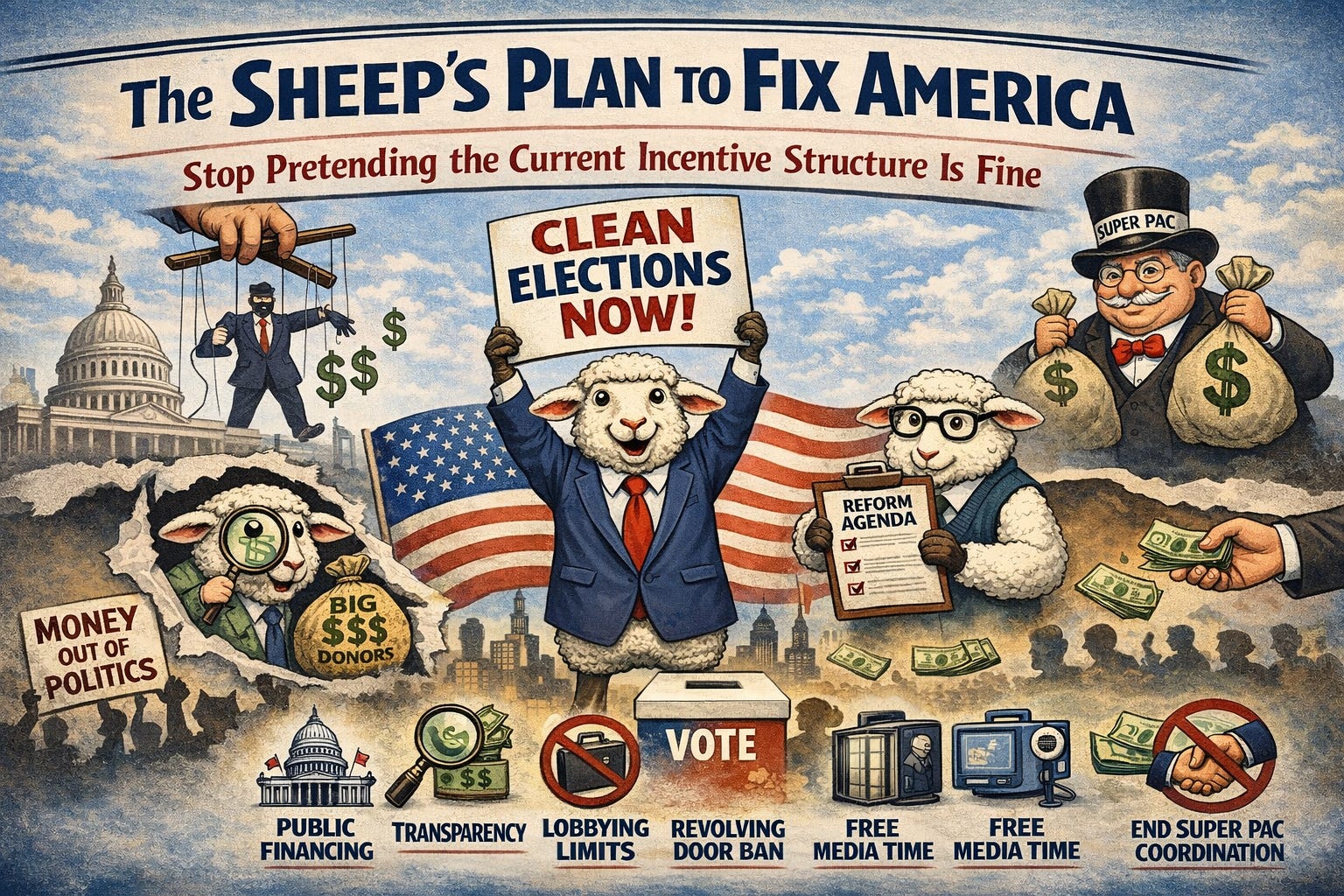
The Sheep’s Plan to Fix America
Or at Least Stop Pretending the Current Incentive Structure Is Fine
I. The sheep’s diagnosis
The sheep are not claiming that every public servant is corrupt or that every donor is sinister. Their point is more structural than personal.
A system can produce bad outcomes even when some of the people inside it have good intentions.
When candidates must spend enormous portions of their time fundraising, and when outside groups can spend unlimited sums “independently,” politics naturally tilts toward the people with the most money, the most access, and the most patience for transactional relationships. Federal law still caps direct candidate contributions, but the post-Citizens United and SpeechNow framework leaves unlimited independent spending in place.
The sheep therefore believe three things:
Good people are screened out.
Many ethical, serious, public-minded people never run because they do not want to spend years begging rich people for permission to serve.Those who do run are bent by the system.
Even decent candidates are pressured to build donor networks, appease power centers, and avoid offending the class that finances campaigns and careers.The public becomes cynical and passive.
People stop believing participation matters when policy outcomes keep tracking wealth and access more than need or merit.
So the sheep are not proposing a slogan. They are proposing an incentive redesign.
II. The sheep’s objective
Primary objective:
Create a political system in which candidates can run, compete, and win federal office without depending on wealthy donors, corporate money, or billionaire-aligned outside spending.
Secondary objective:
Make public office more attractive to talented, ethical people by reducing the moral and financial cost of running.
Tertiary objective:
Break the exchange loop in which donors fund elections, secure influence, shape appointments, and extract policy.
III. The sheep’s core reform package
The sheep would pursue a package, not a single reform, because one law alone will not solve this.
1. Small-donor public financing
This is the centerpiece.
The sheep would push for a voluntary public financing system that dramatically amplifies small donations from ordinary people. This model already exists in several places in some form. New York City’s matching-funds system is one of the best-known examples, and New York State also now has a public campaign finance program for statewide and legislative races. Public financing programs in states such as Maine, Arizona, and Connecticut show that public funding is not some fantasy concept.
What the sheep want:
A $10, $25, or $50 donation from a regular voter should be multiplied enough that candidates can build viable campaigns from broad public support rather than elite patronage.
Candidates who opt in must accept strict limits on large donations.
To qualify, candidates must demonstrate real grassroots support through many small contributions from constituents.
Why this matters:
Small-donor public financing changes who candidates spend time with. Instead of dialing for dollars from affluent networks, they are incentivized to build support among ordinary people. Brennan Center research describes small-donor financing as an antidote to megadonor influence and notes that it can broaden who is able to run.
Sheep framing:
If democracy only works when a hedge fund manager likes your face, it is not functioning democracy. It is a velvet-rope auction with flags.
2. Full transparency for money in politics
The sheep would push for laws requiring fast, searchable, real-time disclosure of:
major donors,
bundled donations,
independent expenditures,
dark-money funding chains where legally reachable,
lobbying expenditures,
and political ad buyers.
Even where spending is legal, the public should be able to see who is paying for influence.
What the sheep want:
24 to 48-hour disclosure windows near elections.
Machine-readable databases.
Mandatory beneficial-owner disclosure for entities spending on politics.
Prominent disclaimer rules in ads.
A unified public “Follow the Money” portal modeled on user-friendly transparency systems like New York City’s campaign finance tools.
Why this matters:
The sheep believe secrecy is fertilizer for corruption. Even imperfect transparency can raise the political cost of naked influence buying.
3. Ban or severely restrict lobbyist and contractor money
The sheep would target the most obviously compromised categories first.
What the sheep want:
Ban campaign donations from federal contractors to candidates and party committees where constitutionally permissible.
Expand restrictions on lobbyist fundraising and bundling.
Impose tougher rules on donations from firms with active regulatory or procurement business before the government.
Require recusal and public notice when major donors have direct financial stakes in pending decisions.
Why this matters:
If someone is actively seeking contracts, regulatory relief, merger approval, tax carveouts, or appointments, they should not simultaneously be financing the careers of the people deciding those matters.
Sheep framing:
You should not be allowed to shop for public policy the way you shop for marina access.
4. Revolving-door restrictions
Money does not only move through elections. It also moves through jobs, access, and future promises.
Federal and state ethics rules already include post-employment restrictions of various kinds, precisely because governments recognize the danger of officials cashing in on public service relationships.
What the sheep want:
Longer cooling-off periods before former members of Congress, senior staff, regulators, and cabinet officials can lobby or join firms they previously oversaw.
Expanded restrictions on negotiating private employment while exercising public authority.
Stronger ethics enforcement with real penalties.
Public databases of former officials moving into lobbying, consulting, and regulated industries.
Why this matters:
If public office becomes a farm team for influence peddling, then campaign finance reform alone will not save the republic.
5. Free or subsidized public campaign infrastructure
The sheep understand that money buys not only corruption, but reach.
What the sheep want:
Free or reduced-cost broadcast time for qualified candidates.
Publicly financed voter guides mailed to every household.
Guaranteed debate access for candidates who meet grassroots thresholds.
Public digital ad credits or equivalent communications support for candidates who opt into clean financing rules.
Why this matters:
Candidates need ways to reach voters without needing private capital. Otherwise, “public financing” still leaves them outgunned by privately financed media saturation.
6. Stronger coordination rules
The sheep know that “independent” spending is often not meaningfully independent in spirit, even when it is legally structured that way.
What the sheep want:
Stronger anti-coordination rules between candidates and outside groups.
Tighter common-vendor, staff-sharing, and data-sharing restrictions.
More aggressive enforcement of sham independence.
Why this matters:
If a super PAC is functionally part of a campaign, then contribution limits are theater.
7. A constitutional strategy for the long game
The sheep are realistic. Some of the biggest barriers are constitutional doctrine, especially after Citizens United and related cases. The Supreme Court has held that corporations cannot be barred from making independent expenditures, and the SpeechNow decision helped create the modern super PAC framework.
So the sheep’s plan includes two tracks:
Track A: Do everything possible under current law now.
Public financing, transparency, anti-coordination rules, revolving-door reform, stronger ethics, debate access, contractor restrictions, and public media support.
Track B: Build toward constitutional change.
Whether through a constitutional amendment, a change in Court doctrine over time, or new jurisprudence, the sheep believe long-run reform requires revisiting the legal framework that treats unlimited political spending as functionally untouchable.
Sheep framing:
You do not win every battle by waiting for the mountain to move. Sometimes you pass state laws, build proof of concept, elect better judges, and keep walking uphill until the doctrine cracks.
IV. The sheep’s political strategy
The sheep are not naive enough to think the current beneficiaries of the system will fix it voluntarily. So they need a strategy for power.
Phase 1: Build a single-issue coalition
The movement must stay disciplined at first.
The sheep would build a broad coalition around one unifying idea:
No matter what else you believe, your vote should matter more than a billionaire’s checkbook.
This coalition would include:
anti-corruption reformers,
labor groups,
good-government organizations,
veterans frustrated by donor capture,
independents,
disillusioned conservatives,
progressives,
faith-based ethics groups,
small business owners,
and ordinary voters who are sick of bought politics.
The sheep would not begin with every divisive policy question. They would begin with process reform as precondition.
Why:
A cross-ideological coalition is harder to caricature and harder to divide.
Phase 2: Turn reform into a moral issue, not just a technical one
Campaign finance talk often dies because it sounds procedural. The sheep would refuse that trap.
They would frame this as:
a fairness issue,
a dignity issue,
a representation issue,
and a corruption issue.
The message is not “please consider adjustments to donor architecture.”
The message is:
Teachers, nurses, farmers, mechanics, parents, and decent public servants should not be governed by a system calibrated around donor appetites.
Phase 3: Win at the state and local level first
The sheep know Washington rarely reforms itself first.
So they would pursue:
ballot initiatives where available,
state-level public financing,
city-level matching systems,
state anti-corruption packages,
contractor donation restrictions,
state revolving-door laws,
and aggressive disclosure laws.
This is not theoretical. Public financing systems already operate in multiple jurisdictions, including New York City and New York State, and states have adopted a range of campaign finance rules and revolving-door restrictions.
Why:
It produces real victories.
It creates proof that alternatives work.
It builds a bench of reform candidates.
It normalizes the idea that campaigns do not need to run on oligarch fuel.
Phase 4: Recruit candidates who campaign on refusing capture
The sheep would identify candidates willing to sign a public pledge:
reject corporate PAC money,
disclose all major fundraising relationships,
support small-donor public financing,
back stronger ethics and transparency laws,
and refuse lobbying jobs for a defined period after office.
The point is not purity theater. The point is to create a recognizable class of anti-capture candidates.
Sheep screening test:
The sheep do not care whether the candidate has perfect branding.
They care whether the candidate can survive without crawling into the donor terrarium.
Phase 5: Create a public scorecard
The sheep would publish a relentless “Who Owns Who” accountability scorecard.
Each federal and state politician would be graded on:
support for public financing,
disclosure rules,
anti-coordination enforcement,
revolving-door reform,
contractor contribution restrictions,
ethics enforcement,
and actual donor patterns.
Why:
Most voters do not have time to parse campaign finance filings. The sheep would translate complexity into clarity.
Phase 6: Make donor dependence politically embarrassing
The sheep understand culture matters.
They would use satire, media, storytelling, and plain language to turn donor capture into a visible moral stain rather than a boring background fact.
Message:
“Bought” should feel disqualifying.
“Funded by ordinary people” should feel honorable.
“Independent expenditure” should no longer function as a mystical deodorant.
V. The sheep’s legislative package
If the sheep were drafting a bill package tomorrow, it would include:
The Clean Pasture Act
A federal small-donor matching system for congressional races, voluntary but generous enough to be competitive.
The Every Dollar in Daylight Act
Rapid disclosure of donations, outside spending, ad purchases, and major funders.
The No Golden Turnstile Act
Longer cooling-off periods and tougher post-government lobbying restrictions.
The Public Office, Not Private Auction Act
Restrictions on donations and bundled support from contractors, lobbyists, and entities with active business before the government.
The Real Independence Act
Tougher coordination rules for super PACs and outside spenders.
The Public Square Access Act
Free media time, public voter guides, debate access, and communications support for qualifying candidates.
The Constitutional Restoration Resolution
A long-term effort to allow stronger limits on concentrated private money in elections.
VI. What success would actually look like
The sheep are practical. Success is not “corruption disappears.”
Success would look like this:
More candidates from normal professional backgrounds can run.
Fundraising shifts toward many small donors instead of a few major patrons.
Officeholders spend less time appeasing elite donors.
Policy bargaining becomes somewhat less purchased.
The public can more easily see who is financing what.
Lobbying and post-office cash-outs become harder and more shameful.
More people with actual character enter politics because the entry price is no longer spiritual self-liquidation.
That would not solve every problem in America, but it would change the machinery that distorts almost all of them.
VII. The sheep’s closing argument
The sheep are not promising utopia. They are saying something more sober:
A republic cannot function well when public office depends on private patronage.
When citizens feel powerless, it is often because the system has been engineered to convert money into amplified political voice. Under current law, direct contributions are limited, but unlimited independent expenditures still give wealthy interests and outside groups extraordinary leverage. Public financing models in places like New York City show there are workable alternatives that can strengthen the role of ordinary donors.
So the sheep’s plan is not “fix every issue first.”
Their plan is:
Change the incentive system.
Reduce dependency on wealthy patrons.
Expand the power of ordinary donors.
Tighten ethics.
Expose the money.
Build from states upward.
Normalize clean campaigns.
And make public service accessible to people who still have a conscience.
That is how the sheep intend to start pushing the rock somewhere other than back onto themselves.