
What the Sheep Remember About Birthright Citizenship
Birthright citizenship was written into the Constitution to prevent exactly this kind of political manipulation of belonging.

The sheep have been thinking about one of the clearest promises in American law, and one of the oldest temptations in American politics.
Birthright citizenship is often discussed now as though it were some bureaucratic loophole or modern policy preference that can be tightened, reinterpreted, or discarded when the political winds change. But that is not what it is. Birthright citizenship sits at the center of the constitutional order built after the Civil War. It was written into the Fourteenth Amendment because the nation had already seen what happens when citizenship is made contingent on ancestry, race, or the approval of those in power. The amendment’s first sentence, ratified in 1868, declares that “all persons born or naturalized in the United States, and subject to the jurisdiction thereof, are citizens of the United States and of the state wherein they reside.” That language did not appear by accident. It was designed to overturn the logic of Dred Scott, in which the Supreme Court had declared that Black Americans could not be citizens, and to make clear that citizenship in the United States would no longer depend on bloodline or political favor.
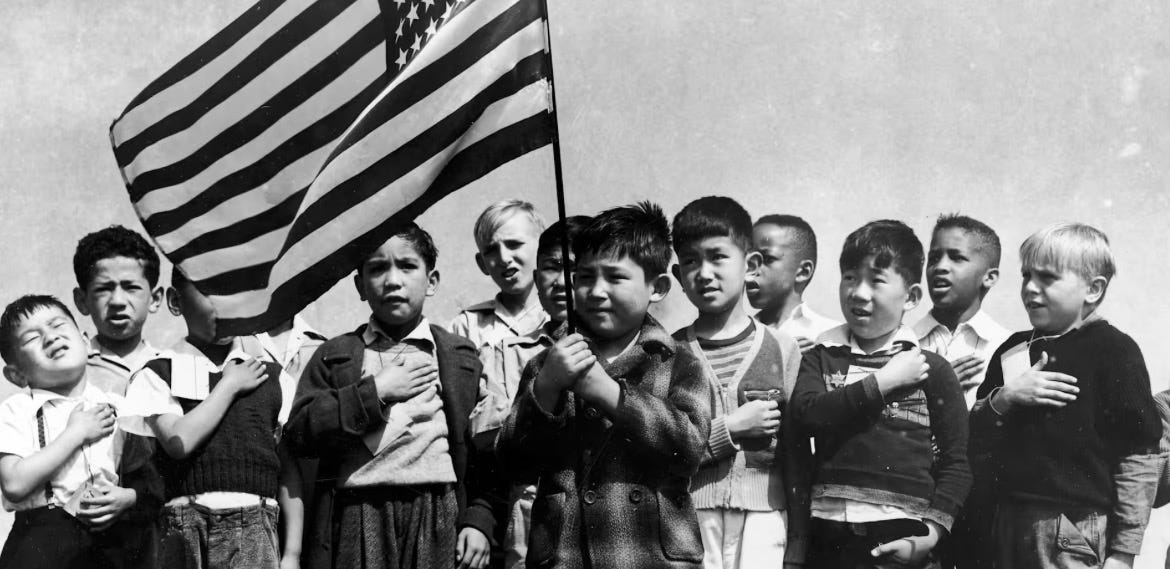
Americans sometimes forget that birthright citizenship was not merely a generous idea. It was a corrective. Before the Fourteenth Amendment, the legal status of whole categories of people could be denied or manipulated by those with power. The Civil Rights Act of 1866 had already declared that all persons born in the United States and not subject to a foreign power were citizens, but lawmakers in Reconstruction wanted that principle secured in the Constitution itself, beyond the reach of future Congresses that might try to undo it. In other words, they were not simply extending a benefit. They were trying to close the door on a system in which American identity could be rationed.
The sheep would also note that the story did not end in 1868, because American history has a habit of writing noble principles into law and then forcing later generations to fight over whether those principles mean what they say. That was the situation in 1898, when the Supreme Court decided United States v. Wong Kim Ark.
Wong was born in San Francisco in 1873 to Chinese parents who were subjects of the Emperor of China and were not eligible to naturalize under the racist immigration regime of the time. After a trip abroad, he was denied reentry to the United States on the theory that he was not actually a citizen. The Supreme Court rejected that argument and held that the Fourteenth Amendment guaranteed citizenship to a man born on American soil, even though his parents were not U.S. citizens. In doing so, the Court affirmed a fundamental rule tied to birth on the land, rather than descent from the right people. That ruling became the great judicial confirmation of birthright citizenship in the United States.
That brings the sheep to the current moment, because Donald Trump is trying to do by executive order what the Constitution, history, and Supreme Court precedent have long rejected. On January 20, 2025, the first day of his second term, Trump signed Executive Order 14160, seeking to deny automatic citizenship to children born in the United States if their parents were in the country unlawfully or only temporarily. The administration’s argument turns on a narrow reading of the phrase “subject to the jurisdiction thereof,” claiming that not everyone born on U.S. soil is fully under American jurisdiction in the constitutional sense. Lower courts blocked the order, and on April 1, 2026, the Supreme Court heard arguments in the case now known as Trump v. Barbara. Reporting from Reuters, AP, and other outlets indicates that several justices, including some on the Court’s right, appeared skeptical of the administration’s effort to rewrite more than a century of constitutional understanding. A decision is expected by summer.
The sheep suspect that what is happening here is larger than one immigration policy fight. Trump and his allies are presenting birthright citizenship as though it were an abuse, a technical mistake from another era, or an incentive for people they do not want in the country. But that framing asks Americans to forget why the rule exists in the first place. Birthright citizenship is not a side effect of a careless constitutional phrase. It is a deliberate rejection of inherited caste. It says that in the United States, the child born here begins as a member of the political community, not as a supplicant waiting to see whether ancestry, paperwork, or public mood will permit belonging. That is why efforts to undo it resonate so strongly with older American conflicts over race, exclusion, and who gets to count as fully American.
There is also a practical question, and the sheep find practical questions clarifying because ideology often hides inside administrative language. If the government succeeds in ending birthright citizenship for some children born here, then someone must decide, at the moment of birth, which newborns belong and which do not. That means the state must inspect parental status, determine categories, track lineage, and create a mechanism for denying national membership to babies born on American soil. AP reports that critics warn Trump’s order could affect more than 250,000 births each year and create a class of children born in the United States but denied the citizenship long understood to attach at birth. A government that can do that is not merely adjusting immigration policy. It is rebuilding citizenship around surveillance and inherited status.
The sheep would put it this way: the fight over birthright citizenship is not really about a loophole. It is about whether citizenship in the United States comes from the Constitution or from the preferences of the people temporarily holding power. The Fourteenth Amendment answered that question after the Civil War. Wong Kim Ark answered it again at the end of the nineteenth century, even in a climate poisoned by anti-Chinese racism. Now the question has returned because American politics has once again produced a movement that wants belonging to be narrower, more conditional, and easier for the state to withhold. The legal issue before the Court is technical in form, but the principle underneath it is old and plain. Either the Constitution means what it says, or citizenship becomes one more thing strongmen try to make contingent on obedience, ancestry, and fear.
And that, the sheep suspect, is why this fight feels so charged. Birthright citizenship is one of the few places where American law still speaks with unusual moral clarity. It does not ask who your parents are, whether they arrived with the right documents, whether they are popular, or whether a president likes the political optics. It asks where you were born. Trump is trying to replace that constitutional simplicity with a hierarchy. The country is now waiting to see whether the courts will permit it.
I accidentally ran across you on IG. I find your commentary among the best of the best.
Best I have read on this subject . . . and the photo of the children is beautiful. Thank you.