


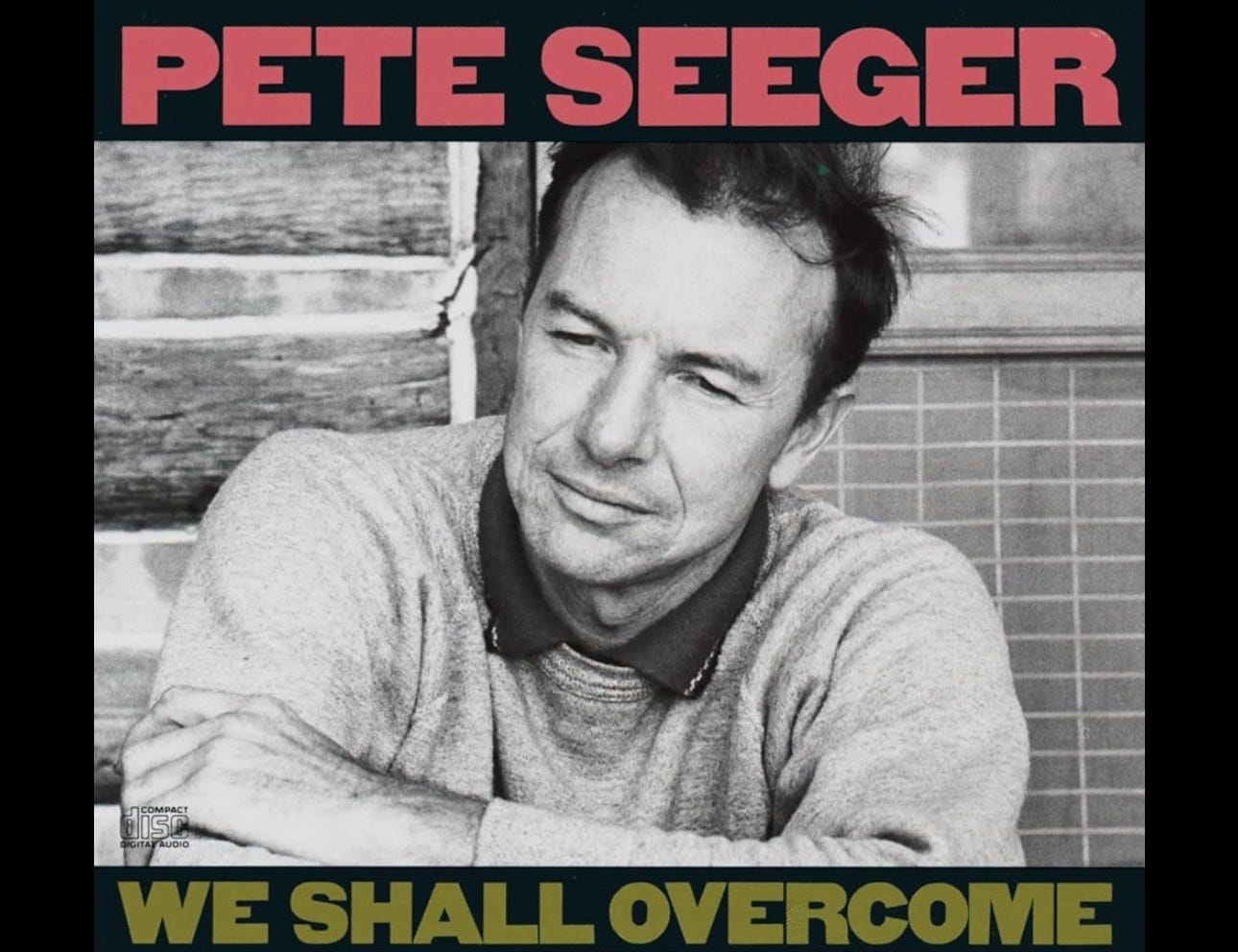
“We Shall Overcome” endures because it is almost radically simple. Pete Seeger helped popularize it in the early 1960s, but the song was already older than the civil rights movement moment most Americans associate with it. The Library of Congress traces its roots to older Black spiritual and gospel traditions, including Reverend Charles Tindley’s 1903 hymn “I’ll Overcome Some Day,” while Smithsonian Folkways notes that Zilphia Horton heard a version sung by Black tobacco workers in Tennessee before Horton, Frank Hamilton, Guy Carawan, and Seeger helped adapt it into the form that became the movement’s anthem.
In other words, the song did not begin as celebrity expression. It came up from workers, churches, and organizers, then became part of a mass democratic struggle.
The song’s central line, “we shall overcome,” is both humble and absolute. It does not promise instant victory. It does not say tomorrow. It does not say triumph will be easy or even visible in the short term. It says only that injustice is not final, and that the people resisting it are making a claim on the future.
That is one reason the song became so powerful in the civil rights movement. It gave people a language of perseverance without pretending that perseverance was painless. The promise is not naive optimism. It is disciplined moral endurance. Seeger’s own civil rights performances place it squarely inside that tradition of steady, collective struggle.
Another key phrase is “we are not afraid.” That line gives the song its spine. The song is gentle, but it is not soft. Fear is one of the main tools of authoritarian politics, whether the threat is jail, violence, humiliation, economic retaliation, or simply social isolation.
This lyric answers that pressure by refusing its emotional terms. Not because the singers feel no fear, but because they are determined not to let fear govern their conduct. In that sense, the song is about courage, but a very particular kind - not swagger, domination, or revenge. It is civic courage, the kind required to keep showing up in public with other people when power wants you quiet and alone.
Then there is “hand in hand.” That phrase explains why the song never sounds like an individual protest anthem. Its grammar is collective from beginning to end. The subject is always “we.” The song assumes that justice is not won by solitary purity but by solidarity, discipline, and mutual presence.
That was true in the labor and civil rights movements that helped shape the song, and it remains true whenever democratic action depends on ordinary people deciding that isolation is exactly what power wants from them. The song’s emotional force comes from its refusal to separate moral conviction from communal action. It insists that people endure together or not at all.
That is why the song fits the current American political landscape so uncomfortably well. In the last two weeks alone, nationwide “No Kings” protests drew demonstrators across all 50 states against Trump’s actions on immigration, war, and what organizers described as authoritarianism, while lower federal judges have continued pushing back against administration actions on immigration and other matters, prompting escalating attacks on the judiciary from Trump allies.
At the same time, a federal judge blocked the administration’s attempt to strip legal status from thousands of Ethiopians. Taken together, those developments suggest a country in which democratic resistance is increasingly being carried not by one charismatic figure, but by crowds, organizers, lawyers, judges, and communities deciding not to yield all at once.
That is precisely the kind of political terrain in which “We Shall Overcome” makes sense.
The song also feels current because it rejects the tempo of strongman politics. Modern authoritarian styles thrive on speed, spectacle, intimidation, and the constant manufacture of exhaustion. “We Shall Overcome” answers with patience. It assumes that democratic struggle is long, repetitive, and often unglamorous.
That may be why the song can feel almost unnerving today. In an era trained to chase the next outrage, the song insists that real political endurance is slower than virality and deeper than performance.
So, the meaning of “We Shall Overcome” in 2026 is not nostalgic. It is immediate. It says that democratic hope is a collective discipline, that fear cannot be allowed to write the terms of public life, and that solidarity is strategic and not sentimental.
It is a song for moments when institutions are under strain, when people are tempted to despair, and when the work of holding a country together has fallen, once again, to ordinary citizens standing next to one another and deciding that surrender is not yet the language they will use.


